 |
| HELPFUL TIPS |
| BCD problems & maintenance 2/4/16 |
BCD's are often neglected until they have problems.
Aside from a sticking inflator, which can be life-threatening in
the worst case, a leaky aircell may be a simple fix or signal the
end of its useful life. In any case, your BCD should be
rinsed well inside and out after use, almost fully inflated for
drying in the shade, and stored in a dry ventilated area to
prevent mold. Annual service of the inflator or alternate
air source/inflator combo is, in my opinion, more important than
regulator service because a sticking inflator can lead to
uncontrolled ascent.
A common problem for shore
divers are sand-choked dump valves, which are easily unscrewed for
cleaning, as long as the cap is not cross-threaded. Dump
valve springs may rust and break causing a big leak.
A
common problem I see with older BCD's (>5 years) is
plastic fatigue. In warm climates these new plastic
elbow and dump valve fittings become brittle and shatter. In
most cases the broken part is a male threaded bulkhead welded to
the aircell, but airway screw-on fittings and inflator bodies can
also crack and fail. If the manufacturer no long has
replacement parts that BCD is no good. Trade it in and
upgrade to a new one.
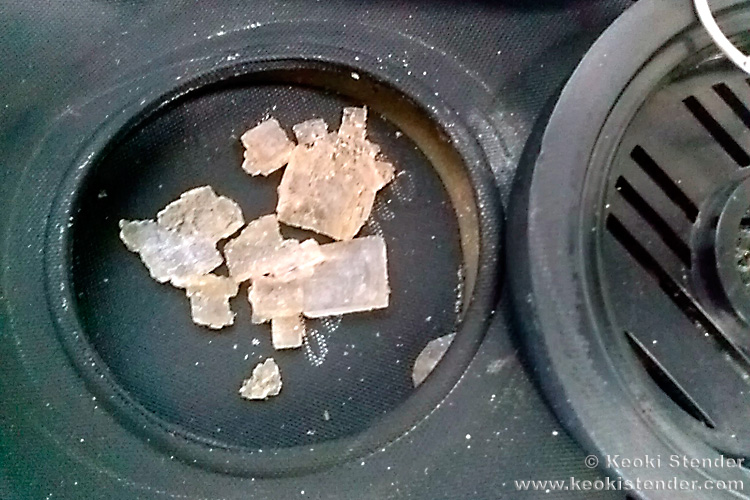
Many
users neglect rinsing the aircell's interior thoroughly.
Over time seawater within the aircell can become supersaturated
and form large salt crystals. In
exceptional cases they can form a large crunchy mass.
Needless to say, these hard glass-like crystals can slice the
aircell, but more often, tiny crystals grow within the aircell
fabric, eventually creating pinhole leaks. These leaks may
be repaired in some instances using urethane adhesive or patching
kits. My policy is to not carry out such repairs, fix it
yourself or uprgrade to a new one. |
| |
| |
| Freeflowing second stage 4/18/15 |
A freeflow is the condition when a regulator second stage
delivers a high volume of gas when removed from the diver's mouth.
There are four situations which cause this, two of which are user
error:
1. Venturi control lever in the wrong
position.
2. Alternate air source improperly secured.
3. Improper airway control when removing regulator from
mouth.
4. Stuck lever or contamination within second
stage.
5. First stage intermediate pressure exceeding
normal specification (both second stages would shudder violently).
While cases 4 & 5 can only be addressed by a technician,
the first three are common occurrences with inexperienced users or
experienced users who don't understand design features of their
equipment. Scuba instructors and dive shop salepersons
should point out these facts so the user has a positive
experience.
|
| 1. Venturi control levers |
| |
| |
| Damaged yoke retainer sealing surface
3/20/14 |
| |
 |
 |
An often-overlooked part of your regulator first stage is the
sealing surface that mates with the cylinder valve o-ring.
In heavily-used regulators this area eventually loses the ability
to seal due to nicks and subsequent loss of chrome plating.
Typical damage is caused when the sealing surface accidentally
hits the valve during setup/breakdown and corrosion occurs due to
incomplete rinsing. The yoke system is a tenuous connection
- the actual sealing surface is only a couple of millimeters wide
as is the metal-to-metal contact around it. Any damage to
the o-ring or yoke retainer flats cause the connection to leak to
some degree, from a minor trickle of champagne bubbles that may be
temporarily halted by rotating the first stage a bit (which shreds
the valve o-ring), to a big leak upon pressurization that can't be
stopped (especially with Pro-valves). The flat sealing
surface can also be warped by using the first stage as a handle
while lifting the scuba unit, and especially when an unattended
scuba unit falls over and the first stage hits the ground,
resulting in an unstoppable leak.
The obvious solution to
this is replacement of the yoke retainer, which must be done by a
certified technician using a torque wrench, since improper
installation may result in catastrophic first stage failure and
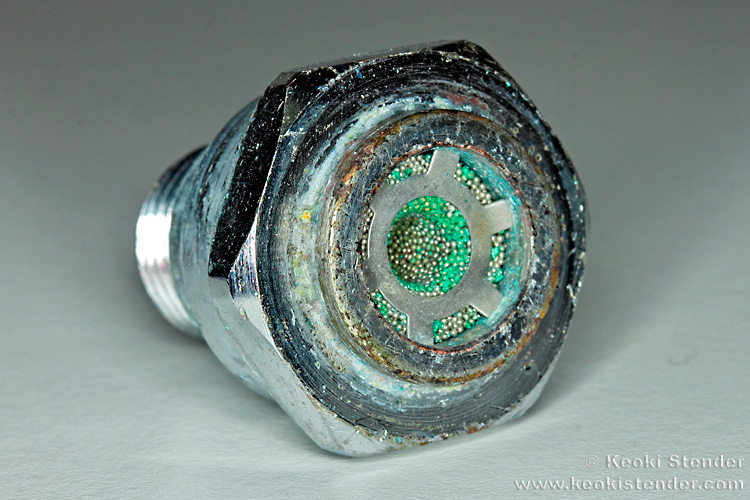
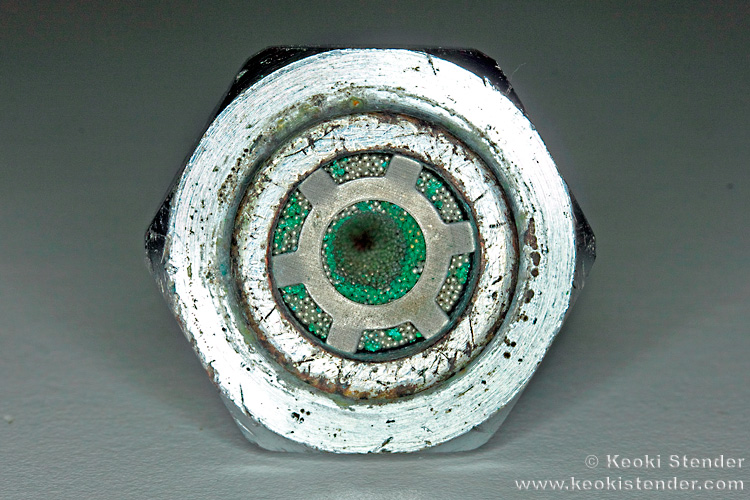
personal injury. Remember that any leak here may allow
seawater to enter the first stage as indicated by green corrosion
on the filter. You should also inspect the cylinder valve
o-ring for damage. See the next section for more
information.
Most modern regulators have replaceable yoke
retainers in the $30-50 range. Models without can only be
fixed by replacing the main body, which is not economically
feasible. These include many Sherwood, US Divers Conshelf,
and Mares MR12 first stages. In these cases, a new first
stage may cost nearly the same as having the damaged one repaired. |
| |
|
Keeping saltwater out of your regulator |
|

There are several ways for salt water to
enter your first stage. One is the result of a damaged cylinder
valve outlet o-ring. When the o-ring where the cylinder valve and
regulator first stage mate is damaged due to heavy use (especially
rental tanks) a small amount of water can get drawn into the
system while breathing. A telltale sign
of such a leak includes hissing before the dive when air is turned
on. Rotating the regulator may stop the leak, or not. Underwater
this appears as a constant stream of fine bubbles behind your head
and you'll probably be annoyed by the 'fizzing' sound.
This is usually a low-volume
flood that corrodes the inlet filter. In worse cases it can flood
the pressure gauge. In time, corrosion will cause first stage
failure, namely a leaky second stage or octopus.
You can prevent this by inspecting
the valve outlet o-ring before use, ideally at the dive shop
because they should have o-rings, and replacing the o-ring if it
isn't in perfect condition. Shops that really care may include a
spare with the dust cap or Sherwood burst disc nut. Keep a few
spares and a sharp tool to remove the old o-ring in your dive
saver kit. If you own tanks, I recommend switching to urethane
(cream-colored) o-rings. They are highly resistant to wear and
last much longer. Trident R014-S for standard Thermos or Sherwood
valves or R112-S for Pro-valves and DIN regulators.
|
| |
| Sand in the second stage causing freeflow |
|
Keeping your alternate air source (octopus) secured near your
chest is important to protect your gear and the environment, in
addition to making it easily accessible in case of emergency.
However there are situations when the best care does not keep sand
out. In my case this happens after a dive at the Halona Blowhole,
not to mention Rescue
Diver training at Waimanalo. If you are unlucky, sand gets stuck
to the regulator's low-pressure (LP) seat and causes a slight but
persistent freeflow.
Aside from taking a few strong breaths or depressing the purge
button a few times in hopes of clearing the LP seat, there's
nothing that can be done to safely fix it while diving. In fact,
turning off the gas supply and fully depressurizing your regulator
while submerged will cause a catastrophic flood and ruin the
pressure gauge. Therefore this can only be done out of the water.
The following technique will allow freshwater to enter the system
where it should not normally be, so I do not endorse it as a 'good
practice'. However, if you are on a dive expedition without access
to a trained scuba technician, this may solve your problem.
After diving keep the regulator
mounted to the cylinder with gas supply turned off and
depressurize the system. Fully submerge the leaky second stage in
a container of freshwater or use a water hose to flush the second
stage via the mouthpiece. Contrary to what you were taught in
Openwater Diver class, depress the purge button a few times for
one second intervals to allow a small amount of water to enter the
system. Turn on gas supply and purge second stage several times,
blowing out the water and hopefully the contaminant. This
frequently solves the freeflow problem but there's a chance that
sand is too deeply embedded into the LP seat, or the sealing
surfaces have been damaged, requiring service or replacement. At
that point the system must be tested and probably overhauled.
There are other
methods to fix this problem but must only be done by a trained
service technician to prevent damage, voiding your warranty, or
personal injury.
If
you are lax when it comes to after-dive cleaning, there's a good
chance large salt crystals may form and corrode any metal parts or
embed themselves on the LP seat. In this case I'll expect to see
you sooner than later, so treat your regulator with proper care.
Your life literally depends on it.
|
| |
|